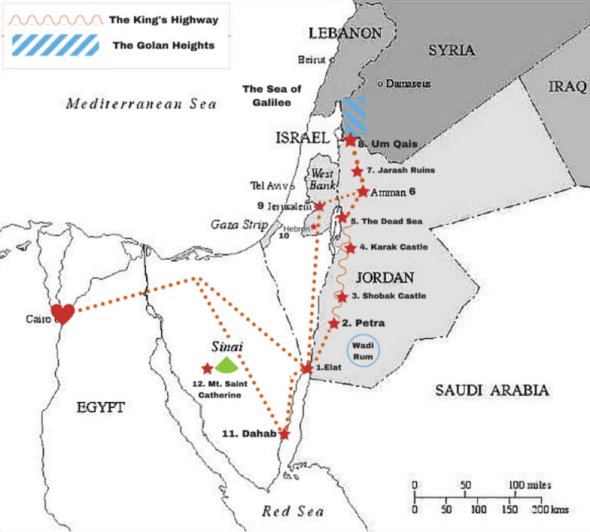
Sweat soaked through my shirt as I sat crammed into a small, and very hot, car winding up the King’s Highway of Jordan. My family had somehow managed to fit all of our luggage (and ourselves) into this tiny vehicle that was now making its way north under the sweltering summer sun. I was a month shy of 16 years old, and the five of us were backpacking through the Middle East staying at hostels and friends’ houses along our route.
We had spent the last few days exploring and hiking around Petra and Little Petra, and were now taking the scenic route to Jordan’s capital of Amman via this old trade road that winds through the countryside. Every couple of hours we would get out and climb around crusader era castles like Shobak and Kerak.
Our car rounded the top of yet another sandy mountain and there across the desert in the valley below us was the Dead Sea. The cool blue water beckoned and urged us forward. There was light at the end of the tunnel as our tired bodies, squeezed into this air condition-less car, screamed for a refreshing break. We were all battered, bruised, and scrapped up from exploring and needed a relaxing cool down.
The minute the car pulled up to the beach I fell out of the side door and crawled toward the sea. I did a quick wardrobe change in a dirty bathroom then ran through the sand to fling myself in.
“OH MY GOOOOD!!” I howled in unexpected horror as my siblings laughed at me from the bank.
The extreme amounts of salt in the abnormally warm water swarmed into every cut I had acquired from scaling rocks and crawling through caves. I had been so taken by the mirage of the sea that I had forgotten the extreme salt content and the fact that we were in one of the hottest and lowest points on earth. My eyes welled with tears from the pain and I jumped back out to stand in one of the cold showers on the beach. I let the icy water pour over me in the open stall as I scowled at the sea that had betrayed me. We had been here multiple times when we lived in Palestine and I was kicking myself for not remembering how harsh it could be.
Up on the mountain behind where I stood was a tall sea-stack said to be the site where Lot’s wife turned back to look longingly at Sodom and was turned into a pillar of salt. Salt. Salt. Salt. I was tasting what torture that transformation must have been for her.
I covered my body in the rich and soothing Dead Sea mud instead of going for a swim.
Although this may have been one of the low points on the trip (pardon the pun) I can’t emphasis enough how breathtakingly wonderful it was to hike Petra or how good it was to visit with friends in Amman. Looking back on that trip I can’t believe the bravery of my parents choosing to haul the three of us kids on such a tremendous journey.
From Amman we made our way north still toward Syria visiting Roman ruins along the way. We stopped at Umm Qais which is at the very northern tip of Jordan. This was one of the most brilliant cities of the Greco-Roman Decapolis and, according to the Bible, was the place where Jesus cast out the Devil from two men into a herd of pigs.
I stood in Jordan next to one of the majestic pillars still boldly erect in the midst of the ancient ruins. Without moving much I turned to my right and looked on to the Golan Heights of Syria, and then to my left down over the glistening Sea of Galilee in Israel. I took a deep breath and relished that moment melting into all the different layers of history.
There was a restaurant embedded in the old city where we ordered a wide spread of various salads, meats, cheeses, and bread. As I started to dip a piece of bread into a bowl of olive oil we heard the startling sound of thunder. Then again and again and again. Everyone in the restaurant was looking up at the sky confused at how clear and blue it was. There was no imminent rainstorm in sight.
My dad pulled our waiter over and asked what the noise was.
“It’s Hezbollah.” He said, and my dad got into a brief discussion with him about the alarming situation unfolding between Lebanon and Israel that summer.
I dropped my bread in alarm as I realized we were hearing the explosion of bombs hitting Israel in the distance. The tangible juxtaposition, between our fun filled family trek and the brutal reminder of the current wave of war in the region, was hard to swallow.
We headed back to Amman that night and in the frigged early hours of the next morning we got on a bus to Jerusalem. Because apparently no amount of bombs would stop the Wheeler family from blazing forward. We were headed into the belly of the beast, but we had been there before. After sitting at a check point for 6 or more hours (security was tighter than usual but always hard to predict) we finally made it through the crossing.
“Thank you for visiting Israel. Have a wonderful trip. Also, we love your President Bush.” Said the smiling Israeli woman behind the check point desk as she stamped our passports into the country.
This leg of our trip was extremely stressful. Our home base was with our dear friend, Sri, in his house in a compound on top of the Mount of Olives. He had the news on continuously and it was terrifying to be berated by the new energy of the war outside his front door. Needless to say, we didn’t spend much time leisurely wandering the streets as we visited friends and sacred sites. Israel/Palestine is obviously a very hard place to exist but the motion of daily life plods on. When you add Hezbollah firing bombs to the chronic tension of the 2nd Intifada it is almost impossible to function. It seemed like everyone around us was on the verge of a break down.
We visited old friends in Ramallah (a city north of Jerusalem) who served us dinner and took us for a walk to Yasser Arafat’s grave. They recounted the stream of air raids, curfews, and snipers sending bullets through their daughter’s bedroom window. There had also been an honor killing, of a mutual friend of ours, that summer that they described to us in substantial detail.
I just wanted to hang my head and cry for my friends and what they had been through. It was difficult to hear about people I once knew being shot, burned, stifled, and traumatized.
A few days later we made our way from Jerusalem to Bethlehem. I remembered driving the 10 minutes easily between the two cities often when I was a kid. Now we had to get out at this monstrous wall and walk through it. I felt like we were cattle being herded through the metal chute inside. We listened to the eerie voices in microphones overhead instructing us to open our bags for inspection and what to do next.
My dad and I had almost been shot at driving a van through a check point, on the road to Nazareth, in 2004. The soldiers aimed guns at us and threatened to pull the trigger. My dad was able to screech to a stop and have a conversation with the border patrol. They apologized when they found we weren’t illegally trying to escape. There had just been a confusion with our papers. Check points were terrifying and unpredictable, but at least we could look at the face of the soldiers and have a personal interaction. The WALL was claustrophobic and completely alienated us from the Israeli guards. It was a sterile environment that removed the human element of the war.
This was a very different Palestine from the one I had left behind.
Once we had permission to enter Bethlehem we burned candles in the church that replaced the stable where Jesus was born, and enjoyed a big rooftop barbecue at our friend’s home nearby. It was pleasant to catch up with everyone we knew in this town, but there was that familiar lurking tense undertone to this reunion too. The conversation always veered back to curfews, bombs, and feeling trapped by fear of what each new day held.
There was an afternoon later on our trip when we were headed to the city of Hebron to visit the Christian Peacemaker Team headquarters. Sri was along for the ride and en route to this town he actually snapped.
Two Israeli soldiers stopped our bus and jumped on to inspect the passengers. My dad told us to keep calm but we were all visibly nervous as we held our breath. The soldiers intimidatingly marched up and down the aisle stomping their heavy boots and swinging their guns. Finally they stopped at a Palestinian man in the middle row. They started pushing his shoulder and asking him a slew of unrelated questions while the man tried to keep up and corporate.
“THAT-IS-ENOUGH!” Cried Sri springing up from his seat. “Stop harassing this man!”
The soldiers were taken aback by this spry Indian’s burst of anger toward them.
“Look at this land!” Sri yelled as he pointed at the fields outside the bus window. “You STOLE it! It is not yours. How dare you harass this man whose land you stand on! GET OUT. STOP! You STOLE it. You stole it. Get out.”
Everyone on the bus was frozen and my dad beckoned Sri to sit down. He did and heaved a shaky sigh as he tried to steady himself. The soldiers laughed uneasily but did get off the bus. They motioned permission to the driver to keep going and we continued on.
It was clear from this visit that Sri needed a break and we needed to head home soon. We offered for him to join us in the Sinai of Egypt for an impromptu mini-vacation and he accepted. If only we could have extended the invitation to everyone we knew in the West Bank.
The instant our van moved through the southernmost Israeli check point of Elat into Egypt…everyone felt a weight lift and we all dropped our shoulders in ease. The German strangers sharing the van with us started cracking jokes that sent everyone into a fit of laughter. We were all pretty hysterical with the light sense of freedom Egypt provided.
Sri stayed with us at our hotel, “The Penguin“, on the Red Sea coast. We were in a rustic resort town off the beaten path called Dahab. I loved visiting Dahab. It wasn’t as overwhelmingly touristy as other resort towns on Egypt’s beaches, and it turned out to be on of the most dramatically relaxing stretches of our trip. We went snorkeling, read books in hammocks, and lounged on our balcony to watch birds fly across the Gulf of Aqaba toward Saudi Arabia’s looming mountains . It finally seemed like we were on a summer vacation instead of an intensive activist training venture
Sri was especially appreciating the unusual peace and quiet. He even lengthened his trip to go along with us to our last destination before we headed home to Cairo: Mount Saint Catherine in the middle of the Sinai desert. There is a monastery (The Sacred Monastery of the God Trodden Mountain built in 800AD) at the base that commemorates the spot where angels carried the remains of the martyred Saint Catherine of Alexandria. It also houses the bones of many other martyrs, and the holy bush that is said to have burned with God for Moses.
DO NOT BE AFRAID.
THIS IS HOLY GROUND.
We stayed at the monastery but didn’t sleep for long as we woke up at 2am to climb the mountain. This ascent is to honor Moses climbing the mountain, perhaps this very same one, to receive the 10 Commandments. There were groups of pilgrims also climbing to the top of the highest mountain in Egypt that night with us. Our legs burned and our chests hurt but the sunrise was the grandest production of the sky I have ever seen.
I looked out over the mountain range below, that seemed to roll on forever, and thought about all of the places we had been to beyond that great expanse before me. I wanted desperately to sprout wings and fly back to being present with my friends struggling to live in Palestine, but all I could do that morning was simply send a prayer out on the desert wind.
 shake the dust