In Jerusalem there is the Franciscan church of Dominus Felvit halfway down the western slope of the Mount of Olives. It is said to be the site on the very first Palm Sunday where Jesus turned to look out over the city and wept for it’s future. The church commemorates this story from the Gospel with a teardrop shaped window. In front of the window is an alter embedded with a mosaic of a mother hen pulling her chicks in close.
As a five year old this was the first image of God that struck me, and stuck with me throughout my childhood. From the church window you could see the city of Jerusalem, the glittering gold Dome of the Rock in the distance, and in the foreground was this loving picture of a hen gathering in her chicks. My dad bought me a postcard, of the mosaicked hen complimented by the city view, during our first visit there. When we returned home to our village I pinned it on the wall next to my bed. It was comforting to outline it with my fingertip and imagine a mothering God tucking me in each night.
This is an emblem of God that I held tight over the years even though I saw God embodied in a multitude of ways afterwards. He was in many colorful mosaics, domed cathedrals, ancient catacombs, the incense of the Catholic Church, the holy water of Latin Patriarchate Church, the convent of the Sister of Notre Dame de Sion, the monasteries of Wadi Natrun, the living rooms of Southern Baptist missionary friends, the hundreds of fronds on Palm Sunday in a courtyard in Beni Suef, and in all the many Coptic Orthodox Churches along the Nile that mark the path of the Holy Family fleeing through Egypt.
Everywhere were relics of His essence and History. I grew up in the region where God walked and whispered and resurrected his son. There was an endless stream of images arranged in tiles, wood, and metal depicting what that meant exactly.
It was overall very confusing bouncing between all these different types of churches and denominations. It was hard to sort out the different versions of God and Jesus’ life. There were constantly new rules, regulations, and interpretations lectured at me. It was hard to pull it into a cohesive picture. I reverted to just trying to keep up with whoever was defining it in the moment.
On top of all this push and pull in the Christian realm I was obviously living in predominantly Muslim countries. I was a significant minority in many ways and most of my best friends were Muslim. Inevitably some conversations veered toward sharing stories of the Koran and explaining their traditions. They had the same prophets and even some of the same parables. These never felt separate from the stories of the bible but rather another version of God to add to the pile.
I sensed God in the quiet streets during Ramadan and in the bellowing, “ALLAHU AKBAR” call to prayer from mosque speakers. On Fridays I would compete with the closest Imam by turning my TV volume up louder, or pause ordering a lunch entree until our waiter was back from noon prayers. Once in a while I would stop to reflect or chant along. It was simply a different rhythm and flow to worshiping an Almighty.
For a few years, between Palestine and Egypt, we lived in Pennsylvania. I was in fifth grade, at the closest county public school, and briefly going through the motions of an average American kid. One afternoon I overheard the popular girl in our class condescendingly explaining, to a group of our peers, that Allah was the “Muslim’s God”.
“No he isn’t. Allah is just the word for God. Allah is God. God is God.” I corrected her.
“No. You’re wrong. He is the Muslim God that they pray to. He tells them to do bad things. My dad told me.” She spat back.
“No, Allah is the word that everyone uses for God in the Middle East. When I open a bible in Arabic it reads ‘Allah’ there too. It’s the same God!” I jabbed as she huffed off upset that I had contradicted her in front of the group.
[لآ اِلَهَ اِلّا اللّهُ مُحَمَّدٌ رَسُوُل اللّهِ (La ilaha illa Allah)// There is no God but God]
Ok, yes, Jesus does change things up a bit. To Christians he is the divine son of God who died for our sins, and to Muslims he is only a respected prophet. However, as a kid I couldn’t see that I was praying to a different God than my friends. The emphasis and route may be different, but it was leading to the same thing.
Soon after we moved back to Egypt I was sitting with a girl my age after a Coptic Orthodox mass. We were parked side by side dangling our feet over a wall and sharing a bag of popcorn. She asked me if I was a Christian and I nodded. Then she turned her wrist over and showed me the familiar small tattoo of a cross that all Coptics bear.
“Where’s your tattoo?” she asked me.
I turned my wrist over and it was blank and white next to hers. She gave me a concerned look and explained that I wasn’t really a Christian without the cross tattoo commitment. I panicked and fought the impulse to race to the nearest priest that would pierce it into my skin.
So, in my mind, we may all be praying to the same God but clearly it was important for Christians to mark themselves apart. It took so much energy to keep up with every denomination I had a foot in, and now I had to worry about what it meant to look like a Christian too?
Our family’s baseline is Mennonite. My parents were working in the Middle East with a Mennonite organization and I was told that was what we were. My dad had converted in college, but my mom’s family can trace themselves back to the boat their Swiss German Mennonite ancestors hopped off of to settle in Lancaster, PA. I am descended from gentle Mennonite farmers who wore the traditional clothes and opted out of fighting in wars.
When someone in the Middle East asked me what I ‘was’ I always answered with the scripted “I’m a Mennonite”, but plop me down in Lancaster county and I wasn’t so sure. I felt just as marginalized in that world as I did on a Coptic Orthodox feast day or at an Evangelical Lutheran candlelight service. I was always welcomed but never fully able to claim any one theological camp or culture. I couldn’t recognize myself in any sect, and I had no idea what my personal religious [self] was or where I belonged. I certainly didn’t wear a head covering or have cross tattoos to help provide a straightforward answer.
Anafora is a Christian retreat center, an hour outside of Cairo, off of the Alexandria desert highway. It is technically non-denominational but run by a Coptic bishop, and workers from Taize, France. It is a peaceful place that promotes sustainable living, and offers a silent space for spiritual formation to guests from around the world. The community makes their own candles and soap, grows their own food, raises camels and donkeys, and has a big library to get lost in. Our family spent a lot of holidays and weekends there through my middle school and high school years.
The architecture of Anafora is inspired by biblical era infrastructure. The walls of each building in the compound are packed with straw, mud, and clay. These materials of choice create a basic earthy atmosphere at the center. Each guest house has a rounded roof that connects to each room on either side of it. My siblings and I loved to climb the outside stairs, to a row of lodges, and jump from roof to roof. I sat up there with friends to watch sunrises, or spent afternoons curled in the dips between two housetops to read a book.
One night I climbed up the clay stairs alone. I leapt from roof to roof as quietly as I could so not to wake anyone up. I perched on top of a particularly tall roof and noticed a flat platform below me. Carefully I slid my bottom down the long clay curve and landed on the even surface. I laid down there on my back to look up at the stars, and stretched my arms out to the sky.
God was pulsing through the night air in and around me. I acknowledged His presence and recognized Him in all things. He was in the mosaics and convents, but also gushing within my veins. I was everything and all of it – not one single way. My breath is the holy incense that wells in the domed cathedrals of my lungs. God is seated on the pews of my atoms, and illuminates this church of blood, flesh, and bones that is my body.
Nothing had ever felt so refreshingly overt, freeing, and overwhelming at once. The intimate energy of God as a creator, mother, and light was palpable on that dark Anafora roof. I was beginning to grasp that each church I had attended was only a conduit to touching something much more vast. God was rippling through me and shattering the stained glass of my convoluted preconceptions. I knew I shouldn’t let any one version of the story distract me from experiencing the reality of [the God] it was attempting to describe.
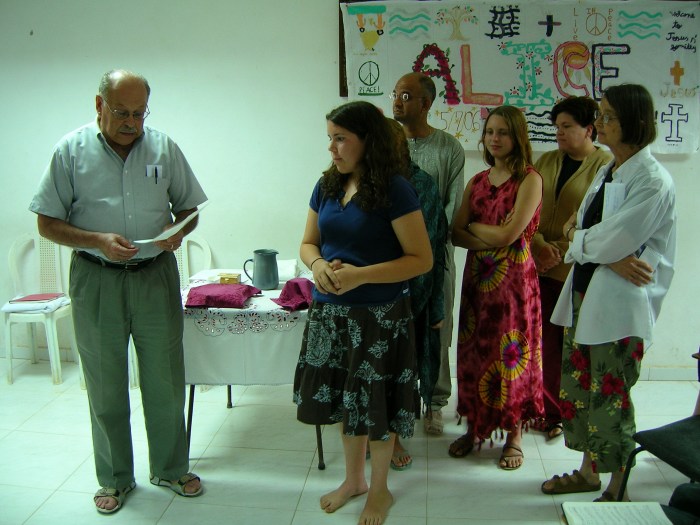
A year later, when I was 15 years old, I made the Anabaptist decision to be baptized. It came together at the annual MCC regional beach retreat in Alexandria, Egypt. My extended MCC family and friends surrounded me as all of the kids surprised me with a hand painted banner they had put together. My friend Sri (from MCC Palestine) had carried a jug filled with the Jordan river across borders, and my friend Ken Seitz (from MCC Lebanon) performed the ceremony by drizzling the water [IT COUNTS] over my head.
I didn’t have it all figured out, still don’t, and never will. But I stood there that day marrying the commitment to continue meditating on my personal relationship with the Love folded into my skin and soul. Standing there I symbolically presented myself, a barefoot Christian with psalms engraved in my palms, to the radical and eternal conversation with God and all His people.
Hallelujah. Praise Allah and Jesus. Amen.
“This woman did not look up to heaven in order to be comforted by an Almighty Father. She looked within and around herself. She found “that of God,” as the Quakers often say, in herself, the strength for resistance. The courage for a clear no in a world that is drunk on the blood of the innocent. And she found another gift of the Spirit, the help of other brothers and sisters. She was not alone. She did not submit herself to a God who was falsely understood as fate.”
– Dorothee Sölle, Theology for Skeptics
 shake the dust